
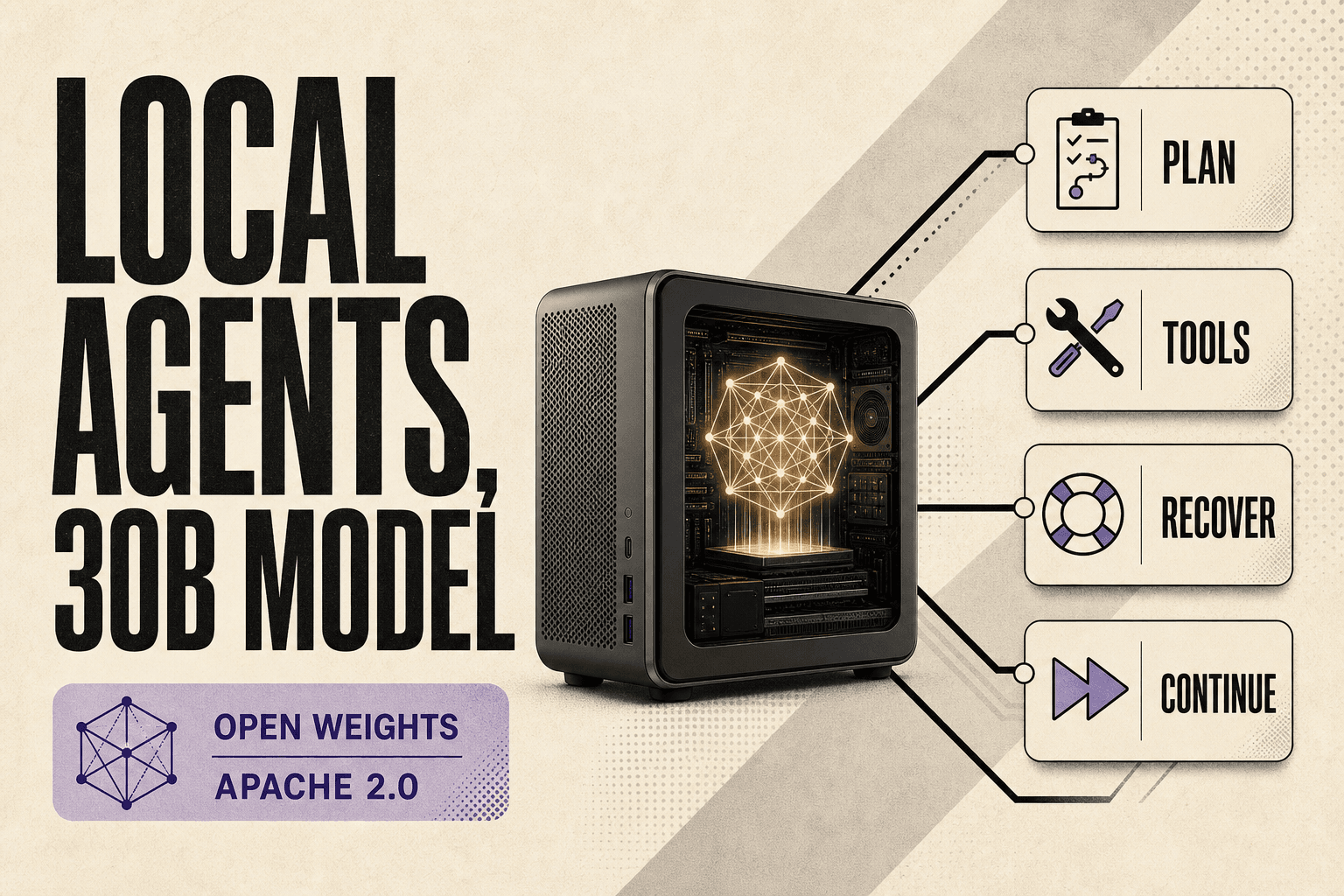
A local model designed for longer workflows
Meta and Unsloth present Muse Glimmer as an open-weight multimodal model with about 30 billion parameters, an Apache 2.0 license and quantized variants for consumer hardware.
The interesting part is not only the model size. Muse Glimmer is designed for agentic workflows where a model needs to plan a task, use tools, handle a failure and continue from the current state.
What can run locally?
The model is available in GGUF and other local deployment formats. Memory requirements depend on quantization, context length, KV cache and how the workload is split between RAM and VRAM.
Unsloth’s guide lists different configurations ranging from roughly 18GB of total memory to 24–32GB and above. “Runs on 24GB” therefore does not mean that every 30B variant behaves the same on every 24GB GPU.
The agent workflow angle
Instead of answering one prompt and stopping, the model can participate in a longer process: plan, call tools, inspect the result, change direction and continue. Persistence also depends on the harness, runtime memory and permissions granted to the agent.
This changes the comparison. It is not only a choice between a powerful cloud model and a cheaper local model. It is also a choice between models that answer questions and models that are better suited to sustained work on a task.
Sources
Muse Glimmer 30B on Hugging Face and the Unsloth local run guide.