
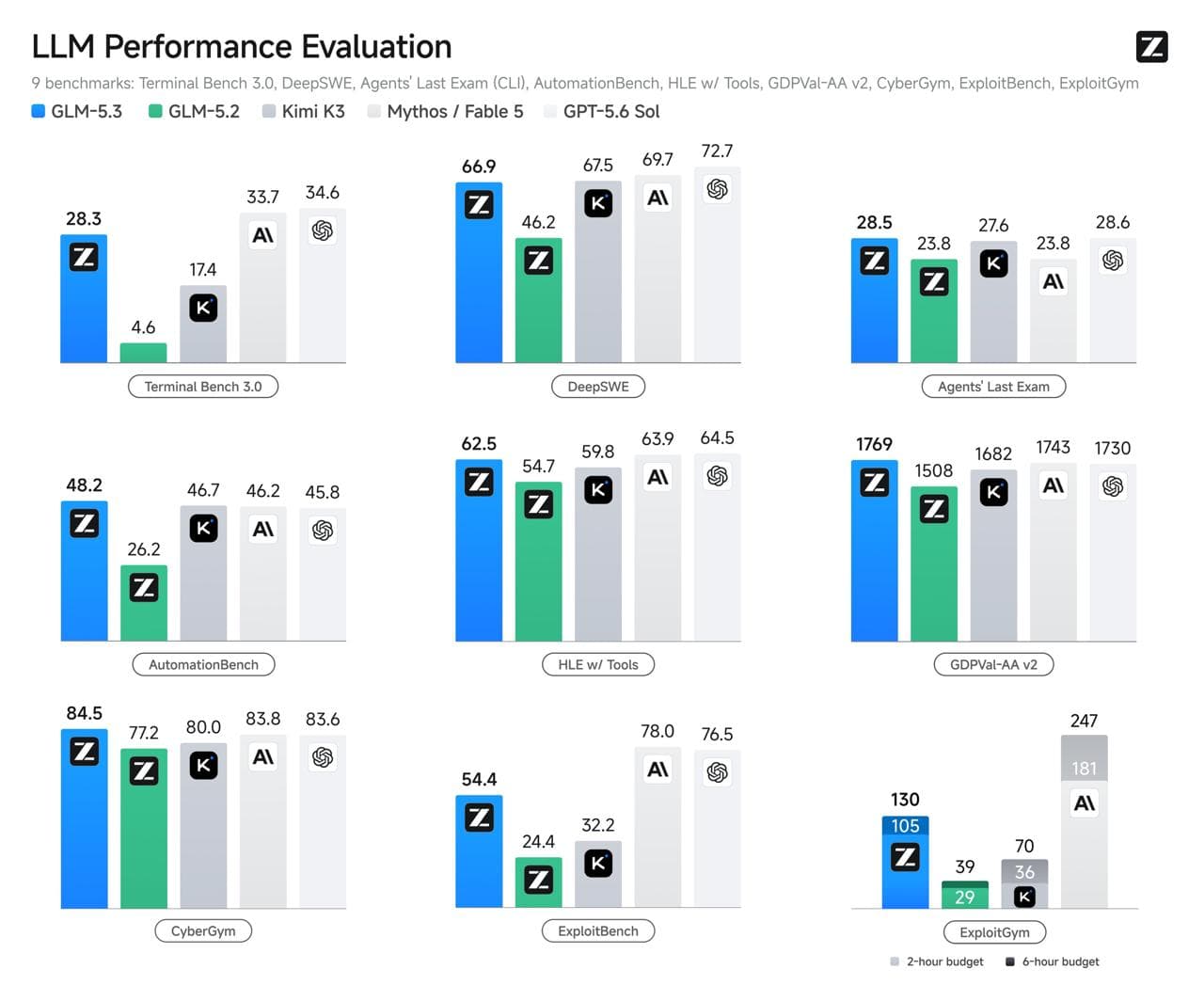
Z.ai has published GLM-5.3, a new open model focused on coding and cybersecurity. According to the company, it uses the same base model family as GLM-5.2, so most of the improvement came from what happened after pre-training.
What changed after pre-training?
Z.ai added more execution environments, longer tasks, stronger verifiers and more Reinforcement Learning. The goal is not only to generate an answer, but to let the model plan, use tools, check its work and recover from errors over longer tasks.
The cybersecurity results
According to results published by Z.ai, GLM-5.3 improved from 24.4% to 54.4% on ExploitBench. In ExploitGym, it solved 105 tasks in two hours, compared with 29 for GLM-5.2.
These numbers need context: benchmark results depend on the environment, available tools, time budget and evaluation rules. They are company-reported figures, not an independent audit.
The broader point
Pre-training gives a model knowledge and baseline capability. Post-training teaches it how to use that capability in an environment: planning, calling tools, checking results and trying again.
That direction matters for AI agents. In a system handling long tasks, the first answer is not the only metric. The ability to reach a correct result after mistakes and revisions may matter more.
Full source: Z.ai’s official GLM-5.3 post
EzraTech perspective
The race toward more capable models is not only about making the model larger. Increasingly, performance depends on how the model is trained to act: the environments it works in, how its output is checked and what happens when the first attempt fails.