
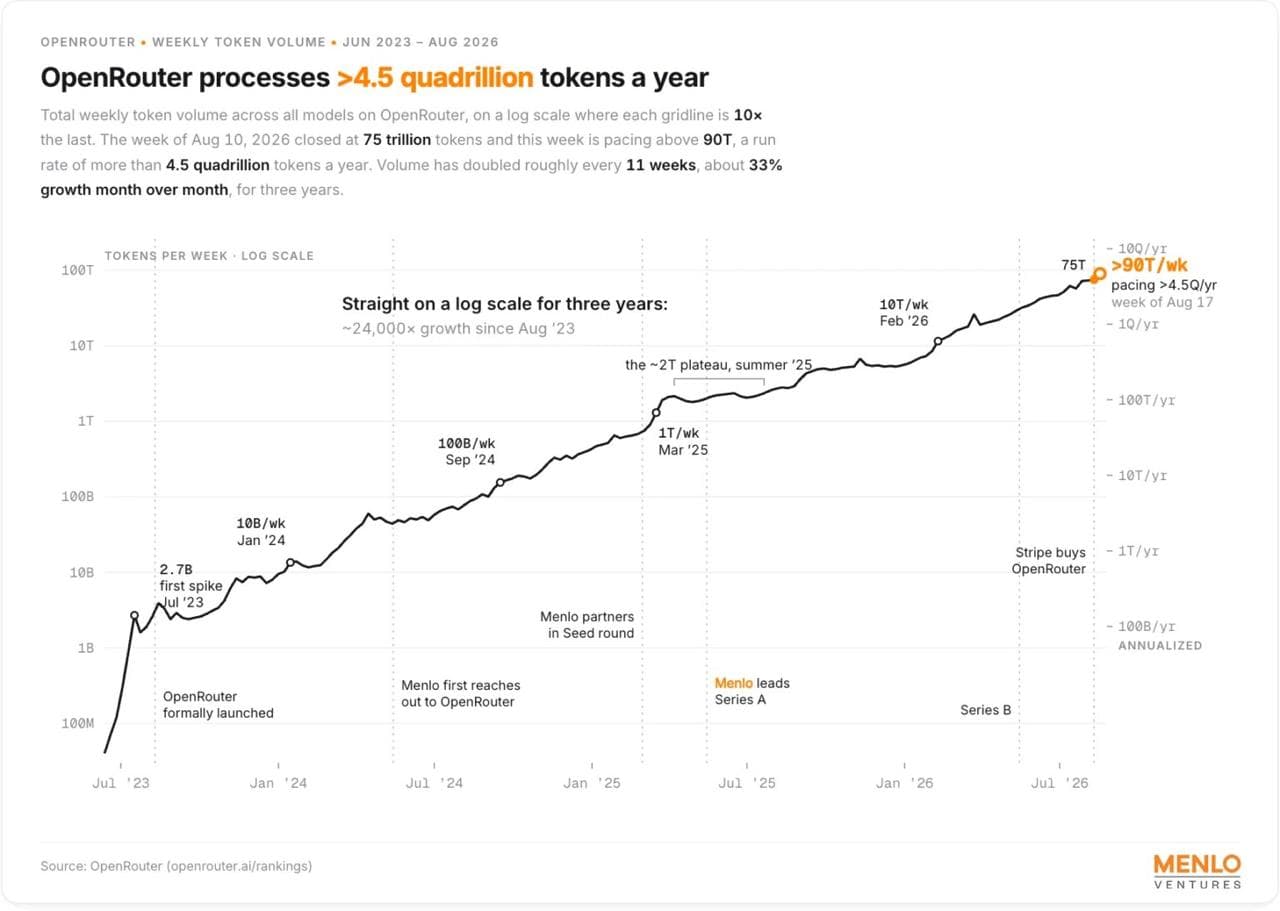
OpenRouter grew roughly 9,000x in about two and a half years
In early 2024, around 10 billion tokens flowed through OpenRouter each week. By August 2026, the weekly pace had passed 90 trillion tokens.
That is roughly 9,000x growth. One important distinction: this is total token volume across the platform’s models, not the number of users or requests.
Agents are changing the economics of usage
According to OpenRouter data, agentic workloads surpassed human usage in token volume around early February 2026. An agentic request consumes roughly 15 times more tokens than a typical human request.
The reason is straightforward. An agent does not simply answer a question: it plans, calls tools, reads results, writes and runs code, creates sub-tasks, and repeats the cycle.
That means the key AI metric is no longer only the number of users. It is also the amount of computation required to complete one task.
This helps explain why model routing is becoming a critical infrastructure layer: it lets developers choose between models and providers based on cost, latency, quality, and availability.
My takeaway: the shift from chat to agents is not just a change in interface. It changes software’s unit of consumption — from an active user to a long sequence of computational actions.
Sources: Menlo Ventures and OpenRouter.